Sometimes a song can catch you in a moment, striking a deep chord, as if speaking to you from the most profound truth or reality that you could encounter in that moment.
So it has been for me recently with this stunning composition from Beth Gibbons (Floating On A Moment – below) which was released in February 2024 and hails from the Lives Outgrown album. The algorithm presented it at the time of release and it came across like a classic immediately. I had also included it for some writing on an unfinished post, but recently coming across it again in this live version brought it back into vivid focus.
To be clear the song is a real achievement in orchestration and arrangement, instrumental voicing meeting poised and affecting melodies, added to which we have Beth Gibbons with an iridescent lyrical clarity.
“On the path, with my restless curiosity, beyond life,
before me,
A passenger on no ordinary journey, it’s one of a kind,
won’t get left behind…
I’m floating on a moment don’t know how long,
no one knows, no one can stay
all going to nowhere, all going, make no mistake“
*
The Thought
When we are finally alone without the honey’d thought of afterlife, the soporific panacea suddenly dispensed with, what can also be found there – in that moment, is a shuddering-awake to the presence and intensity of being alive now, being in the moment.
I’m floating on a moment don’t know how long
There is an obviousness to the expressive power of its sadness. Pitchfork in a review following its release described it as ‘heavy’ – but for me the song transcends this as in any way defining, instead prevailing us as part of its’ sonic wave – in a direction of wonder. It is in touch with the intensity of our mortality and by its reflection on life – the unsaid possibilities (‘…won’t get left behind‘).
It struck me, when recently coming across this piece about Jeff Bridges experiences upon being seriously ill, that it was essentially a similar expressive circumstance. As he says at one point:
“The very things you are trying to avoid – cancer, death, whatever – are where the gold is“.
Jeff Bridges
In fact it is a song that tells it’s own story; Gibbons’ identification of the facets of the journey (and what the song is in expressive becoming with). At the beginning we learn it comes out of the aforementioned ‘restless curiosity…beyond life‘ while it’s titular chorus lyric defines its motion and presence as ‘floating‘ – a movement beyond gravity.
It also bears note that a conceptual dislocation is also involved here from how we normally describe things – in being on rather than in the moment. In a way I find this of particular interest as a place to find a move towards exteriority, because we are so attuned to the intensification of being as a movement into the full presence of the moment, and yet here – a direction change.
Sonically, the song is also a demonstration of rising, the chorus is structured as a melodic rise through its chords. It takes the charge of escaping gravity with levity. It does not succumb to a heaviness of finality, which it looks instead to use as a means to see as much into and out of life as possible and importantly, takes on the role of informing us to use death as an ‘advisor’ (to borrow the Castaneda term) in being and in perceiving the moment.
*
From its earliest moments and to which it returns, the sound of breathing resonates, as if the song while being given over completely to the exploration of life, is also in its own way alive…
There are two facets to the song which I think are interesting in respect of it being in some way beyond gravity (or the ‘spirit of gravity’ as identified by Neitzsche) – a double freeing-up. First from escaping the ‘prison’ of the prevailing functionality of chronic time; becoming a more intense expression of the moment such that the moment becomes the expansive tableau for all the time that we have (‘All we have is here and now’) while secondly the weightlessness in the moment itself – floating as the gentle cousin to flying, seemingly if anything a differential of speed. And yet a third aspect emerges here by this inference of the gentle attribute of floatation – there is no violence in this expressive necessity of a changed motion of being, a realisation that ushers us towards the Daoism of Way and its reference (via Hinton‘s translation) ‘Yielding is the method of Way‘.
*
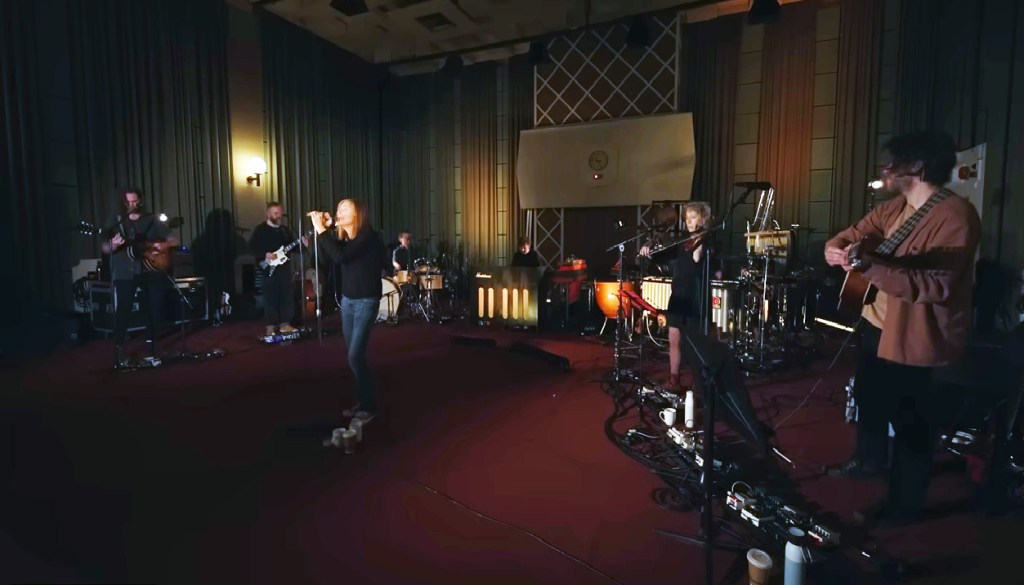
While primarily minor in tone, the sonic aspect of the song escapes its own corresponding regions of gravity, something beauty alone cannot achieve. But here song-writing dynamics give us both the feeling of that disjointing having taken place with the structure of the guitar riff being so effective – like a puzzle – a garden of forking paths in sonic form. Then also when the song breaks out to the chorus, Gibbons makes sure we have that sonic uplift, the brightness of composition and arrangement so that the moment being sung can have its luminosity, of discovery, giving us abstract (sonic) connection of a more energising kind as we are lifted through the melodic journey.
*
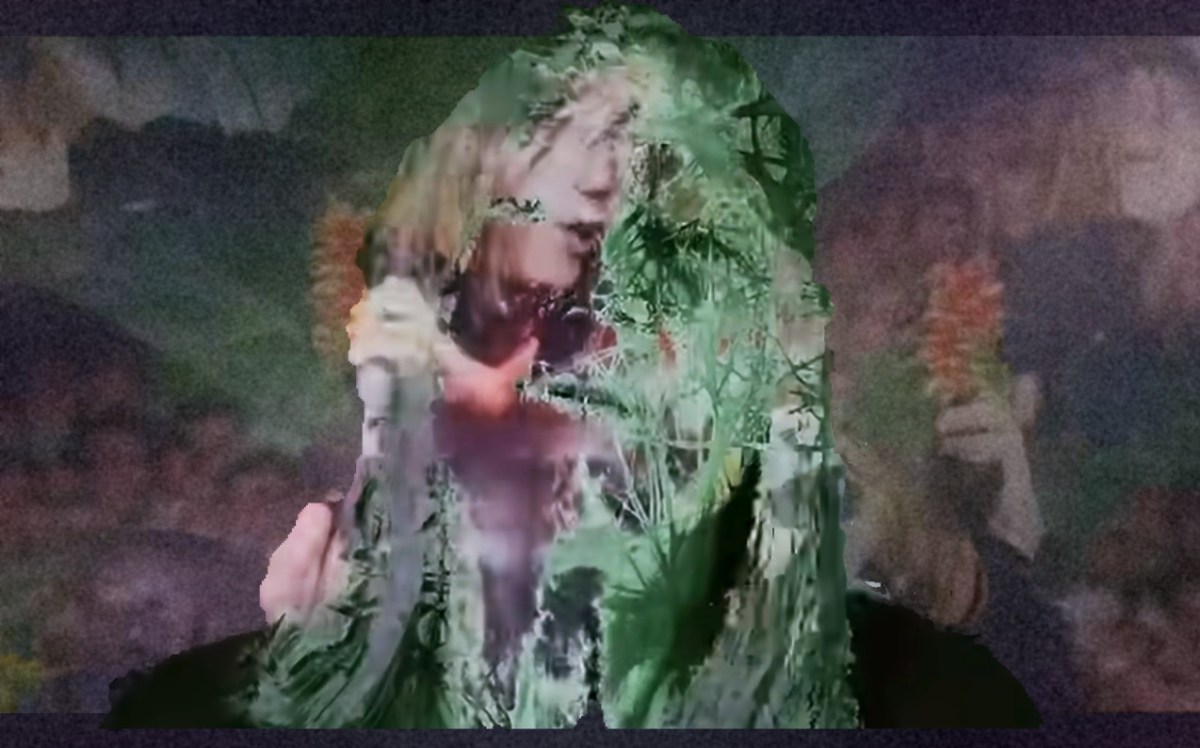
Tony Oursler does a very good job of pushing the visually expressive element through the video that accompanies the song (above). Partly an AI-generated metamorphosis, it creates a tableau of life from the juxtaposed mundane, the scenic, punctuated by morphed out choir faces, skies and scenes of nature – with Gibbons throughout, a transparent feature, morphing away herself while being both there and not there.
It finally makes the case for the cosmic, ending among the stars – Gibbons hands around the sun – the vast celestial unknown that she mused over in Portishead’s extraordinary Wandering Star. A song that while being about the cosmic reality of bodies (of vast and seething light and fire) is of their journey in unending dark and in danger of missing their very luminosity as a result. ‘Wandering stars, for whom it is reserved, the darkness, the blackness forever‘. Also one suspects what might be missed from such a brilliant and foreboding description – is the reality of seeing space (and spacetime) beyond the very human faculties that can sometimes in their scope, end up fixated on things like ‘the darkness, the blackness forever’ (and this despite the illuminating aspect to such a composition in the first place).
Ultimately though, I’d contend that what’s most significant about this video is that while it simultaneously points us toward the planet and the celestial, it also embodies a kind of representation that seeks to express the oceanic in the wider intensity of a life of human feeling and experience, of memory and loves. It is hedging out towards being a psychotropic journey in its own right, the melting of certainty and the melting of traditional models of spatial delineation and the disconnected autonomy of objects.
*
The Larger Reality
There is a point in the song that we reach and that is invoked in the title of this piece; necessarily involving the idea of a totality of now. As Gibbons indicates lyrically, we are seemingly in the position of having such little to go on ‘beyond life‘ in terms of any form of empiricism / epistemology. The question returning therefore to life itself and Gibbons’ position that ‘all we have is here and now‘. In fact this statement becomes the pressure point of the song lyrically and conceptually, it reinstates the present, connecting with the here and now while most crucially, including any unknown extent of our being and it’s own unknown extent (that there are aspects of our being which belong to us, and aspects of our being which belong to life itself). While we may say that we may potentially come to know either or both of these things to some extent – it would not seem that this readily occurs sufficiently ar all through the untransformed accoutrements of reason nor the technical dominance of the tenets of modernism and postmodernism.
It would seem rather that a schematic of intensities is required to both measure the possibility of the here and now and also it’s real, illustrative and responsive depths. Travel intent further towards the world, and the way is populated unfathomably with opportunities at engaging well the moment and its denizens, even for whom our encounters might be spent mostly asleep in our experiences. Such a journey is marked by steps understood each and all as transformation, difference and intensification.
The here and now, the dream of our uncollected lives, the extents, the intents, the bubbles of recollected streams of the stream of our existence. This is also the on-ramp of our chance as living beings, to continue to grow at radicality of our being, against the spirit of gravity, against Blake’s rightful identifican of the sheer scale and destitution of human cognitive and ontological circumstances in his 1794 poem London.
In every cry of every Man,
In every Infants cry of fear,
In every voice: in every ban,
The mind-forg’d manacles I hear
William Blake; London
I wrote more about that here, while I am also reminded in general of this song, about Mark Fisher’s key assertion in londonunderlondon that ‘you find yourself in a mortifying structure that precedes you, you only have a lifetime to escape‘.
A most unassuming gate for a prison
All of which leads me ineluctably to a kind of lucid dream I once had – about 8 years ago, it was relatively brief but genuinely vivid. I found and knew myself to be in a large open prison, though for its duration, I only ever experienced myself alone there. It was a warm evening as I found myself quite near the exit; an opening in the white painted chain link fence through which travelled the compacted dirt road that also ran inside the prison. The light came from both sides of the gap, at the top of the waist-high fence with a pair of quiet white lights shining out as well as onto the grass below.
There was a vague feeling of presence, in that I was aware that someone or something was around and watching. However the way out of the prison was open, you simply had to walk through it…
It was then that I became aware why the prison was open, because I saw in the darkness beyond the opening the unknown. The prison was open and apparently unguarded because to leave, you knew you were leaving behind everything familiar, the prison was everything you had come to know and understand (or not) and accept. I knew in that instant that escape was extraordinarily difficult, being one of ontological tranformation; its tools the ongoing intent towards lucid exploration, alongside the courage to follow where it leads.
“On the path, with my restless curiosity, beyond life…”
Beth Gibbons ‘Floating On A Moment’
***
 reflectivewavelengths