
The Walls of Perception

While recently taking in the lovely 2012 song ‘Lazuli‘ (above) from dreamy Baltimore-sprung synth-pop artists Beach House (Victoria Legrand and Alex Scally) I began to think more about the video directed by Allen Cordell. Along with the song’s beautiful, cascading background-sadness affect, the video quickly establishes itself as being of both the quotidian and the cosmic, while in terms of the latter it will become clear it is an aspect of the darkly-accented cosmic that is primarily in view.
The stories taking place in the video take us from the collectively mundane (and impoverished) to the cosmic via a man at the bar drinking beer, a starving homeless boy roaming the streets and a woman with haunted kitchen. The last of which settings borrows from 1984’s Ghostbusters imagery with its effects presenting the incursion of an extra dimensional space within the perfect hum-drummery of the inside of a refrigerator (screencap below).
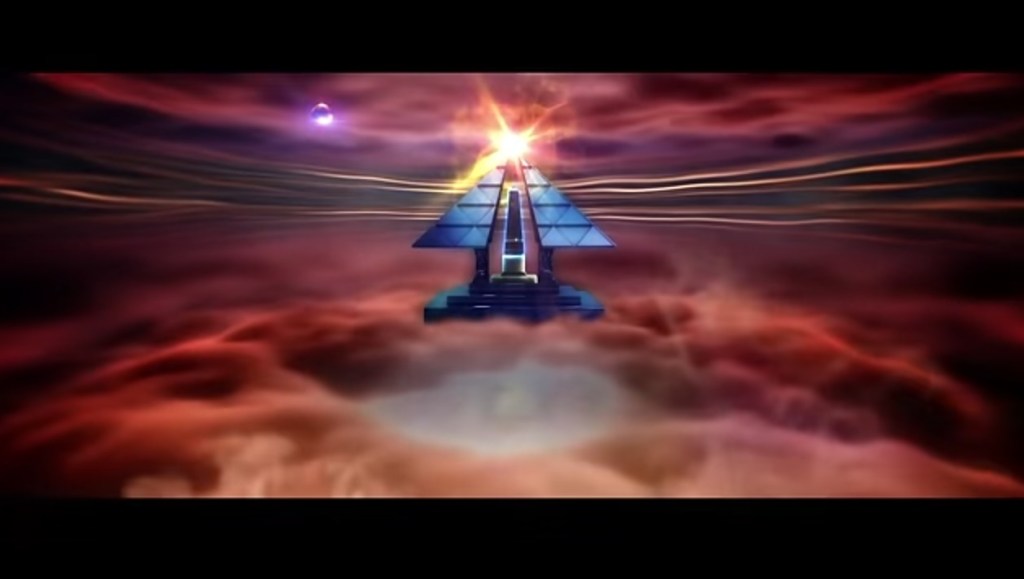
In this respect and with it’s tapestry of excursions from the real, the video comes to act almost as a folk-video for a visual grammar of dark extraneity. The sense of this furthered through the repetitive (including the final shot of the video) static-filled television screen in the living room of the woman – the media-ised unspace that exists in the 1982 Tobe Hooper film Poltergeist (and within which becomes trapped the Carol Ann character in that film).
All three of these characters in the video end up in some way encountering or creating the circumstances through which they leave the everyday formation of the real and arrive at travelling across a space above an abstract-looking topography that in visual terms is a series of monolithic (partly lit) buildings or up-crops alongside other pylon-like structures (below).
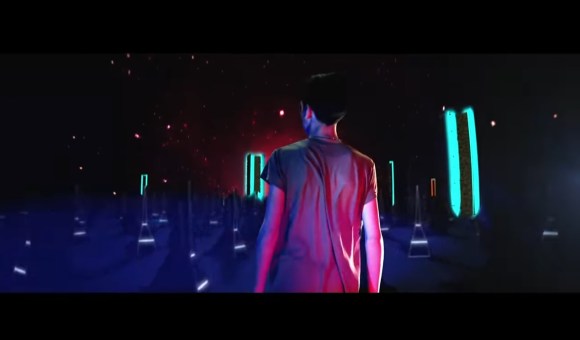
The starving boy who in following some wind-blown pieces of trash, finds an ostentatiously presented meal on a table on the sidewalk, and while eating it, suddenly drops his food and pushes against the air in front of him. It takes shape to his touch and like the dislodged blocks of a wall, falls backwards to reveal the abstract-like space beyond (above).
Partly this moment in the video resonates because of the sense of rupture and the momentary connection this embodies, a visual re-coding that imparts a liminality to the concrete functioning of our perceptions of the world and of the real. Albeit in terms of the latter, that one could think of if it as an actual expansivity, to include the experience of other kinds of place or encounter.
Affairs of Abstraction
Perhaps recently this idea of the permeability of the formation of our reality in perception is something that has been tied up in questions of simulation – some of which maybe unhelpfully so, and yet here it seems like the cultural touchstone of the Matrix film and its impact might be resonant. Part of this is tied into a collective sense that connects with William Blake’s succinct summary at the head of this piece. That human contact with the world-at-large has become unknowingly redacted, the ommissions and separations of which predominantly invisible or forgotten. That is until something changes the world in our being and perception – as is occurring to the characters in Cordell’s video for Lazuli.
“Giacometti was once run down by a car, and he recalled falling into a lucid faint, a sudden exhilaration, as he realized that at last something was happening to him”.
Timothy Levitch (Waking Life)
*
It is also germane that the video – even while depicting its characters traversing these other spaces, simultaneously flashes back to each of them (shrouded in smoke) in their daily-life circumstances of driving and sitting on the street, or in the kitchen respectively. Thus inferring that these experiences may be abstract or stemming from abstract-perception. Only can we infer deviation from the final scene of the video, in which the woman protagonist is (like Sigourney Weaver’s character in Ghostbusters) wrapped within demonic limbs (that she has clasped) and is being propelled bodily in her chair, towards the revealed space.
As such while in the totality of the story that the video gives us – there is a kind of threshold being crossed that involves re-forming perception (no one else in the bar sees what our beer drinking protagonist sees for example) and a re-writing of the notion of (at least partly abstracted) spacetime – a sense of danger pervades, the protagonists are in some sense becoming lost (‘like no other you can’t be replaced’ is the song’s closing lyrical coda). When adding the static filled television as an allusion to Poltergeist, the tableau includes the spiritual other-spaces of both that film and Ghostbusters (both of which include that humans are captured or rendered to those places) alongside the unwelcoming technological space of quasi-abstraction through which all three of the protagonists are at times shown to be in motion (with its towers and pylons).
*
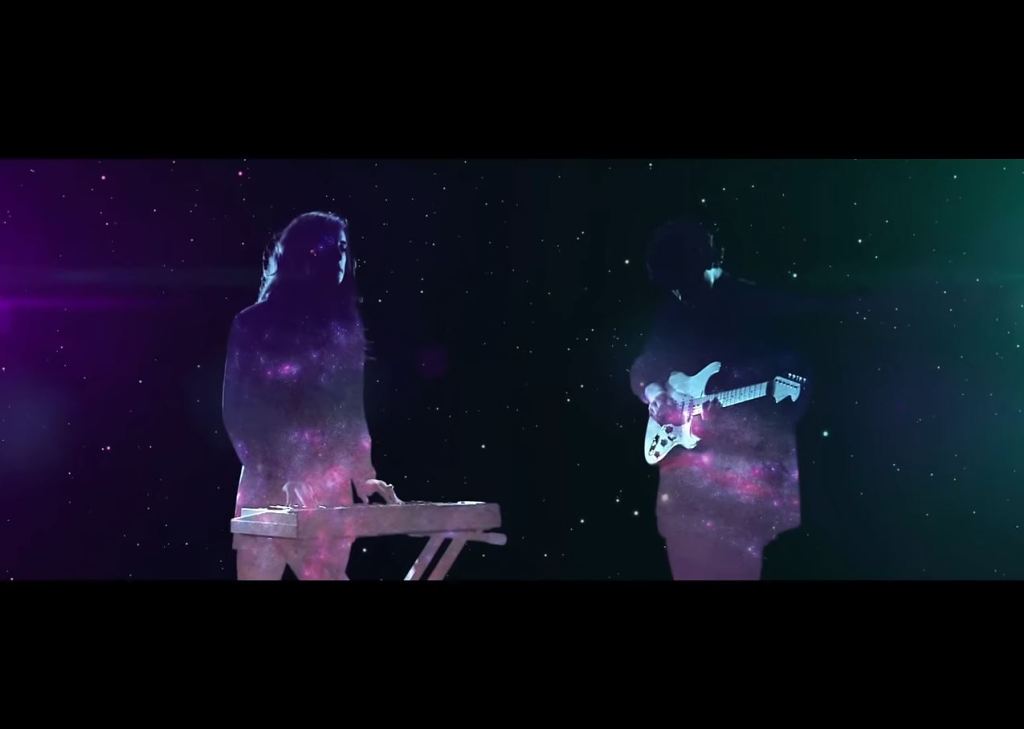
Just to return momentarily to Director Allen Cordell’s consistent framing of the group in the cosmically spatial setting where they play (screencap above). In this role, they are lyrical observers and storytellers for the video and the encounters and experiences of its protagonists. More than this, it is vital that the band are shown as beyond or partly beyond the world of daily life themselves. They are presented as part of the cosmic – consciously so and are positioned in this way as a result. In this respect also, they become part of the lineage of the image of the shamanic and those who have used music as part of a process of going beyond the curtails of the everyday functioning of perception in its molar extent and through that – bringing knowledge and understanding that can help contextualise the human present in wider terms. In the wider terms of Cordell’s stories, while the characters go beyond the real, virtually all the means by which this is achieved apparently involve becoming trapped or lost in the process – any kind of counter-part to which we see only in relation to the band and their setting.
* *
(Contact through a human past) It’s All Around You
To some extent, an additional thought occurs from the above regarding the work of Allen Cordell and Beach House. This being a question that relates to human perception; that in the past – and in some cases, quite recent past (especially the Native peoples of the Americas, South Asia, parts of Africa, Northern Europe and elsewhere) alternative forms of cognition and perception were in effect in humans within some of these groups. Specifically also that these social and tribal groupings could house with more equivalence in their very fabric, different cognitions of meaning and intent – the imperceptible asymmetries of realisation.
From this to the idea that a human connection with the planet and with deeper prevalences of the world with its formations more available and active for humans. The correlate of which now being that here in the dominant late-capitalist modernity – in terms of perception and our sense of the planet, we become impoverished descendants of these peoples. Clearly this is not a homogeneity and yet one thought that occurs at this point is precisely the remnant fragments from the Aboriginal people of Australia, whose deeply-woven and transformative eloquence of the ubiquity and power of ‘dreaming’ as song, creation, mode of perception and time is as futural as almost anything else one comes across in this space.
*
Beyond Anachronism
Partly what occurs in this video by David Scott for the Tortoise song ‘It’s All Around You‘ (from the 2004 album of the same name) – is along the lines of re-interpolating ancient human ways or contexts within the modern and largely urban.
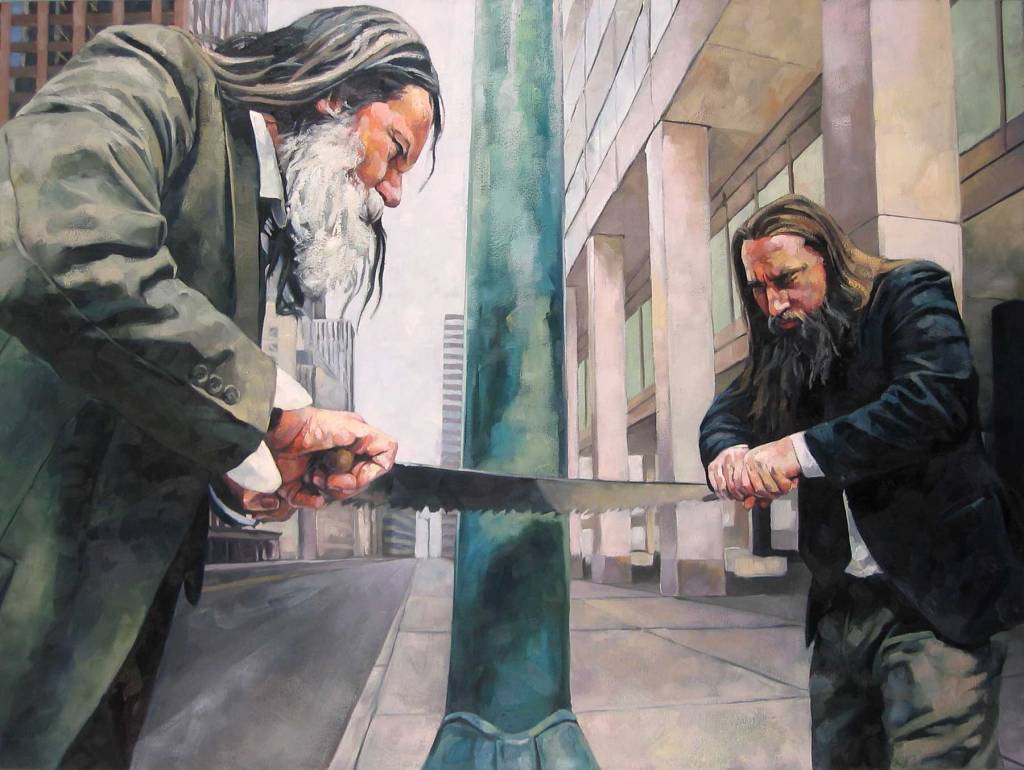
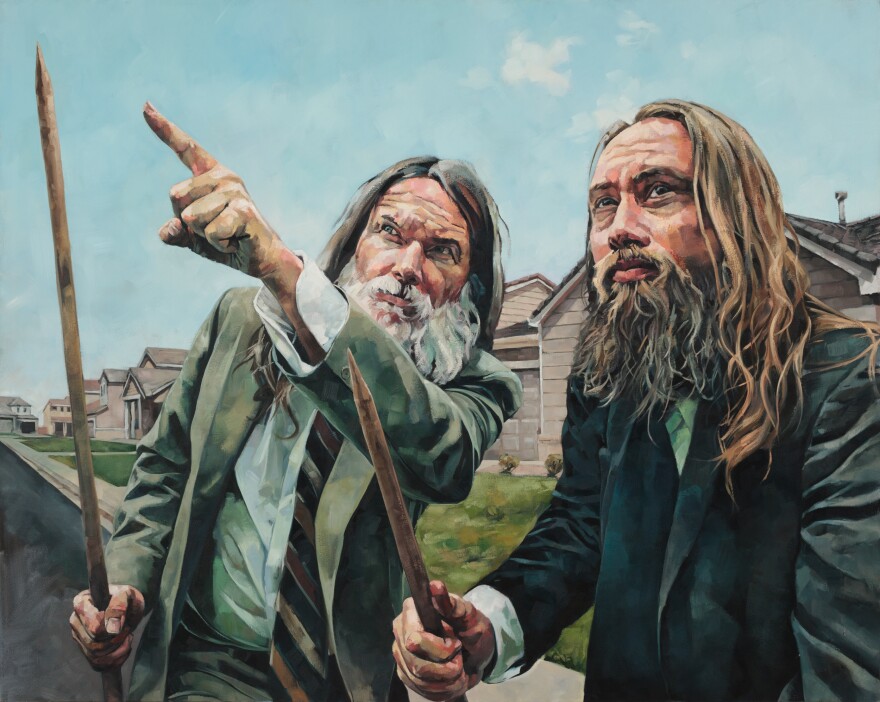
Inspired by some of the paintings of Wes Magyar (two of which are featured here, above and below) and which the video seeks to present, it follows a series of characters through vignettes of apparently anachronistic practises – yet also timeless in meaning, taking place in a modern setting. Among other things, with its uninterrupted passages, it invites us to consider the invisibility (or ‘normality’) of these anachronisms as they are presented – as well as an aspect of what it might be to live in connection with older forms of the practises and modes of our own lineages.
This doesn’t suggest a reversion or destruction of modernity itself – as per for example the circumstances in Ursula K. Le Guin’s short story ‘Things’ originally published in 1970, where human beings indiscriminately destroy all built vestiges of the modern (which is shown to be another senseless adjunct to the disasterous problems of the human trajectory).
*
Trajectories and Transformation
Scott’s video also calls to mind the under-mentioned Michel Gondry film ‘Human Nature’ from 2001, scripted by Charlie Kaufman (trailer above).
One idea through the course of the film seeming to be that humans (or more specifically; human men) do not return from a process of becoming civilised – to a condition of wild or ontological-belonging with the immanence of nature. It should be thought specifically that this applies to the expressive-organic and abstract of the planet – in forms of potential alliances, predations and involving thresholds of understanding and cognition – viz. perception. And yet if the suggestion is that there is an absence of return to a kind of deeper connection – it does not mean that what is being engaged (perhaps minimally) through older practises or forms of living, cannot be rediscovered or re-engaged, or that the intensity of living more closely connected with the planet, cannot re-emerge in different forms of its multiplicity.
As such, this is not to say that the past is in unalloyed manner, the direction of the future, more so potentially what was understood and lived in the past becomes part of the navigation towards the future (in the partly abstract terms of understanding the future as living at higher degrees of intensity).
In his song from 1979 ‘The Thrasher‘ Neil Young travels until the ‘pavement turns to sand‘ and produces a cosmically charged tableau of life (beyond the stratification of ‘crystal canyons‘) a space mostly devoid of his friends (‘the motel of lost companions‘) and yet the spaces of the song are charged ultimately both by death (what becomes the eponynous Thrasher) and the apotheosis of the planetary as the cosmic.
Where the vulture glides descending
Neil Young ‘The Thrasher’
On an asphalt highway bending
Through libraries and museums
Galaxies and stars
I wrote about this song previously, yet what emerges now in the context of the Scott video for Tortoise, seems to relate specifically with Young’s lyrical reference to museums. In the context of the song, the vulture (and previously the eagle) are both also partly abstracted – the highway on which the vulture flies, travels through the aforementioned museums (as well as the libraries before being finally connected with the ‘Galaxies and stars‘). While the libraries of the lyric are the repositories of abstract knowledge (to quote the title of the 2010 EP from British duo Raime ‘We Must Hunt Under The Wreckage Of Many Systems‘) museums are the conveyors and treasurers of the objects of antiquity.
It is suggested at one point in the books by Carlos Castaneda that museums are spaces where it is possible to experience a change to one’s perception. That they are in some way spaces of possibility in relation to experience, where contact with different, more charged and (maybe) more authentic forms of living can be effectuated. Alongside which must come into focus both these objects which museums possess and the affective space of their concentration. It may also end up being one of those things that can be thought of as a form of dreaming (in the transformed manner mentioned above).
*
In terms of Magyar’s paintings that were the inspiration for Scott’s video there is a more direct eponymous re-connection. The modern notion of ‘The Meeting’ (further above) is the scene where the men attempt to cut down a modern urban pole, while ‘The Hunt’ (below) features our spear wielding crypto-ancients in suits – against a suburban backdrop, pointing in a huddle towards unknown landmark or prey or direction. The modern in each instance, interpolated with this ancient analogue of itself.
There is an additional correlate to all this. While Tortoise’s song and album title (hailing from 2004) suggest an immanence intensive to the planet, or the potentiality of circumambience itself – David Scott didn’t produce his video for the song ‘It’s all around you’ until 2007. And yet it hardly seems coincidental that Tortoise’s next studio album – arriving in 2009 was called ‘Beacons of Ancestorship‘ – a further elucidation of the idea of a way forward for humans, in some form back through the lineage of our connection with the planet.
*
Hitch and Connection
Returning once more to Scott’s video and it is necessary to touch upon its imbalance in respect of the roles of the characters being almost exclusively male, which is unfortunate. The more or less lone female, undertakes art work on the paving slabs – and yet here again the uninterrupted aspect of proceedings gives pause – as well as the feeling of ‘atomicity’ (these are individuals and at most duo’s) partly resonating with the sense of Young’s motel of lost companions. Returning once more to an idea that pursuing such a direction – involving a gesturing of the abstract or an intensificatory consistency of life (which can also be called ‘Way’) will generally put one directly at odds with the cognitive flow, mores, and foundational fixities of very many of the humans encountered along the way (and the mindsets by which they are predominantly employed). This at least begins to offer a crumb if nothing else against the setting in Cordell’s Beach House – with its insularity of the characters and their experiences. While still cellular in narrative, the incumbents of Scott’s Tortoise video can be accompanied and in some kind of grouping, the basis of shared, transformed cognition and of the aspect of contagion involved in creating shared worlds of perception.
In a modernity that results upon an expanded insularity of life and experience for many – encountering this shared aspect in its foundational sense should not be downplayed, especially not when – as with fragments of Scott and Magyar’s imagery – we are re-setting a basis for action. As with ‘The Hunt’ (below) – where a direction is being given – a passing on of what has been understood or seen. In line with this – perhaps should be understood Cordell’s contributions in respect of Lazuli – one can be lost or captured in ways abstract yet real. As such, a return through the helical and the still living extant forms of the past, incorporates to know the hunt from both sides and in this wider sense the escape in broadest human form, as the thing truly worth pursuing.
* * *
 reflectivewavelengths