Most of us come across the odd meme or video of an extraordinary feat culled from Parkour. Adrift in the seas of algorithmic imagery, it has become an accepted cultural wallpaper of the sublime. Feats of quasi-sorceric accomplishment on the part of human bodies, invested mostly among the unyielding vertiges of the modern conurbation. Looping among cat videos and prat fall japes on social media as explosive eye-candy waiting to dare those watching to genuinely consider and understand the reality of these moments.
For me, this came in the early autumn of last year, when a video from the London parkour team Phat blew me away with the magnitude and fervour of their endeavours, undertaken with a vibrantly supportive but precision-eyed reading of spaces and risk.
In some respects at the cutting edge of distance and power with their high level technique, team Phat led to me finding the YT presence of the most successful Parkour team in the world, the Brighton-based Storror (gaining their unusual name from an antecedent of one of the team’s brother contingent, Max and Benjy Cave – a figure so apparently remarkable that successive generations of the family’s children each take the appendage as their middle name).
*
Components / Resonances
I had probably accumulated as much surface cultural gleanings as others when it came to Parkour – learning only recently more of its formation and development. It has for example, an unusual multiplicity in its cultural history, for a long time it has also been freerunning and in recent years has been heavily influenced by gymnastics (though others might say that ‘tricking’ has been part of parkour since its earliest days). While a discipline that draws on many endeavours, from climbing to dance and martial arts – a cultural milieu of the street and skateboarding among other things, it has a primacy that in many respects sets it apart, as being about the body and spaces – flexibility and permanence, simplicity and ongoing creativity, fuelled through bravery and daring. A very intense recipe.
One of the things I find most fascinating about Parkour’s more abstract connections are to do with it’s inception in France at a time when Philosophically, France has been at the heart of many developments in modern Continental Philosophy. Relevant conceptual roots and antecedents can be found in the concept of Guy Debord’s “Theory of the Dérive” (1956) – with its emphasis on becoming dislocated and transformed by being lost and by drifting with the moment through urban psychogeographies of the unknown and unfolding. I tend to feel that it’s with Deleuze and Guattari and their emphasis on different formations of sub-culture in relation to deterritorialisations and the strata – that some of Parkour’s more fascinating intensive aspects arise. The nomad fluidic and smooth in action over the striated as active process of intensification of engagement with spaces, fields of motion and fluency.
*
An early breakthrough in terms of public consciousness occurred from Sebastian Foucan, a founder of freerunning platforming these skills in contrast to the bull-dozing Daniel Craig in 2006’s Casino Royale. He had begun developing the discipline alongside fellow Frenchman David Belle in early 1980’s Paris – as a mode of engagement of the body, intensified in relation to the planes and obstructions of the urban, its rooftops and walls, the instrument for a fearless ballet formed in a concrete-dreaming.
Some forty years later, Parkour strikes me as being a sub-culture of the intensifying body that transforms distances and spaces, creating new freedoms through commitment, skill and judgment. Techniques for opening spaces of sometimes brutal magnitude to crossings and landings that arrive at a transformed and beatific relation to human fluencies, balance and power.
Geo-Social
In how Parkour is mostly encountered, online videos – we also see it as a form of exploration (in the intensive as much as the material). In this respect, some of Team Storror’s videos exploring ship wrecks, abandoned structures and subterrenea make complete sense alongside the fact that much of their success also lies in their co-forged sensibility of joyful support while genuinely facing the unknown.
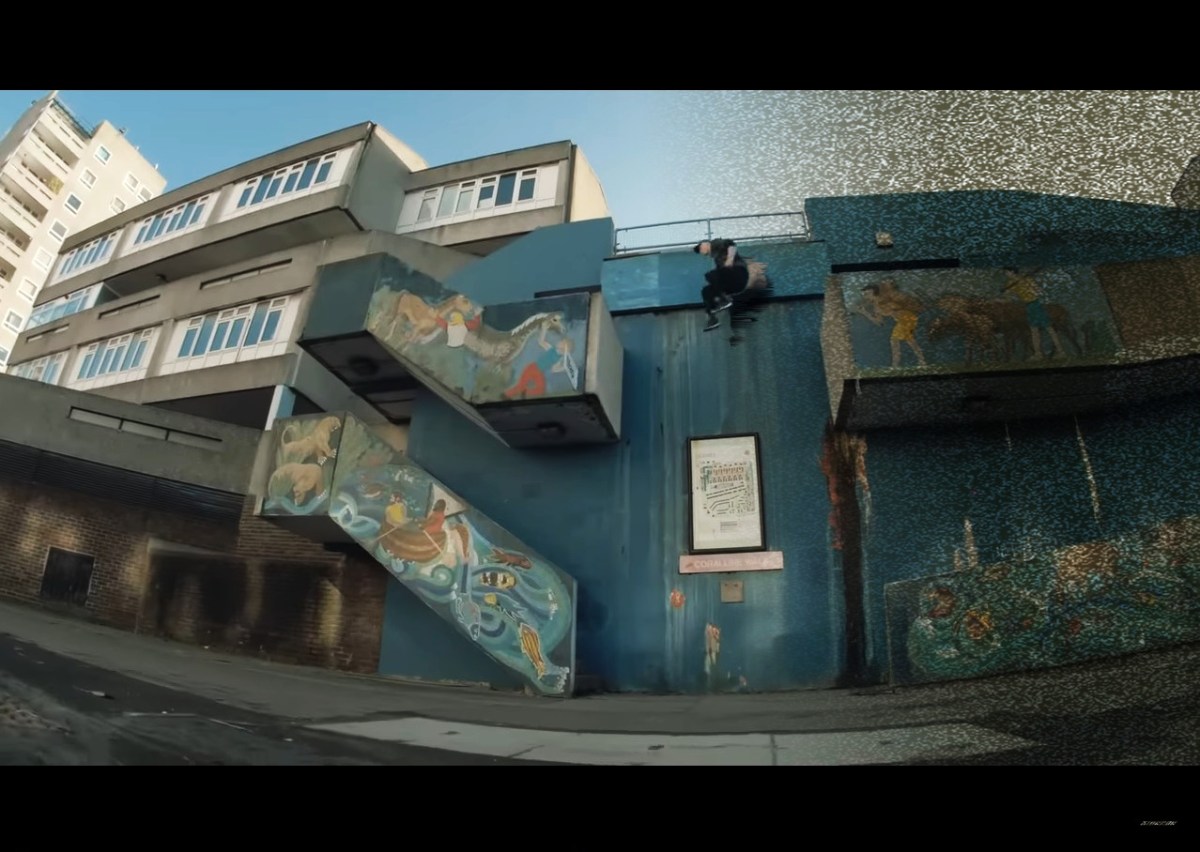
No environments are seemingly immune – given the right conflagration of surfaces, even ‘dodgy, horrible piss stairways‘ as Storror’s Callum says in one Brighton-based video. Even the reviled, neglected nothing-corners of city streets, the nooks and excreted crannies can momentarily serve as points of take off, or over-flight. In this sense, it becomes an action for redeeming even the most abandoned aspect of the human-built environment, a different perception that is intrinsically linked with architecture and micro-architectures transformed as surfaces and vectors.
An inverted world where Storror’s Drew can say of rundown old public housing ‘these estate spots in London are world class... ‘ They come to seem, in some of these bountiful videos, like Parkour-levellers performing in a folk lineage, transgressing the private enclosures of modernity but also visiting the habitations of the masses in towns and cities all over, the housing estates, shopping centres and streets. Attracted by the brutalist, the bricked enclaves of steps and platformed courtyards, as well as other urban installations that create new opportunities to leap, fly, slide and stick landings. In the video above (Parkour Vs BMX) they bring in a BMX team to each attempt a summit on a high peaked roundabout installation in the middle of a busy interchange of roads in Dagenham near London.
In terms of the social of Storror themselves, occasionally a kind of blokey aggro-banter can emerge – although they are mostly tilted towards the wondrous in their trajectories. Whatever one might feel about the culture that seems to emerge in terms of Parkour or Storror, any critique feels churlish as the final arbiter of their approach is often whether they survive intact or not.
Concrete… zero forgiveness, the only movement is your skin moving out of the way of your bones.
Benjy Cave
*
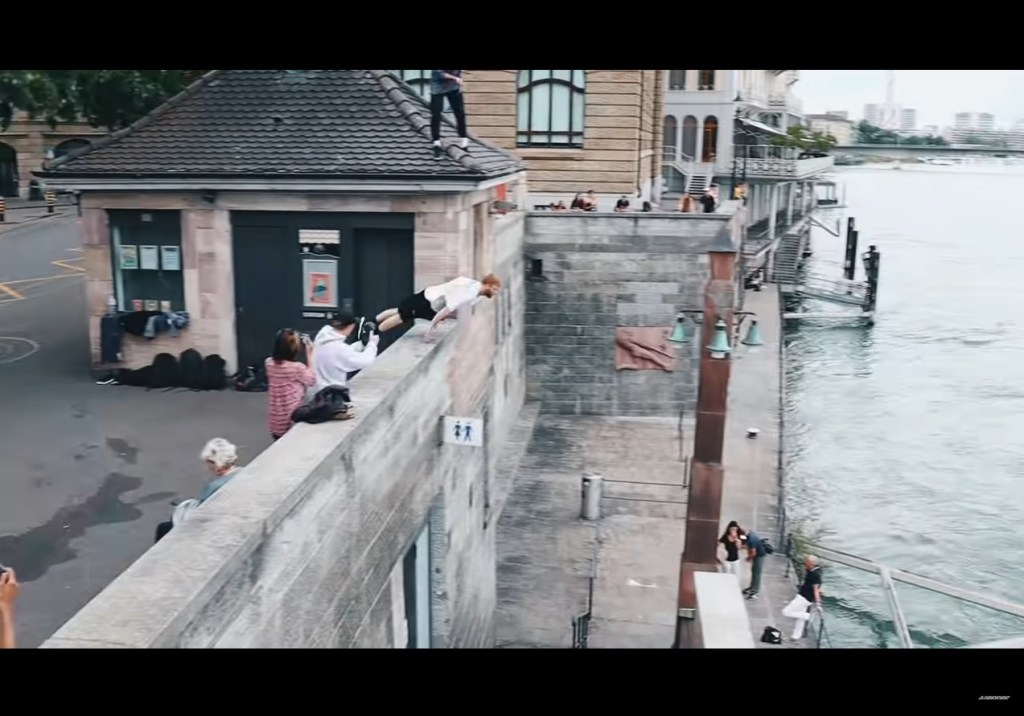
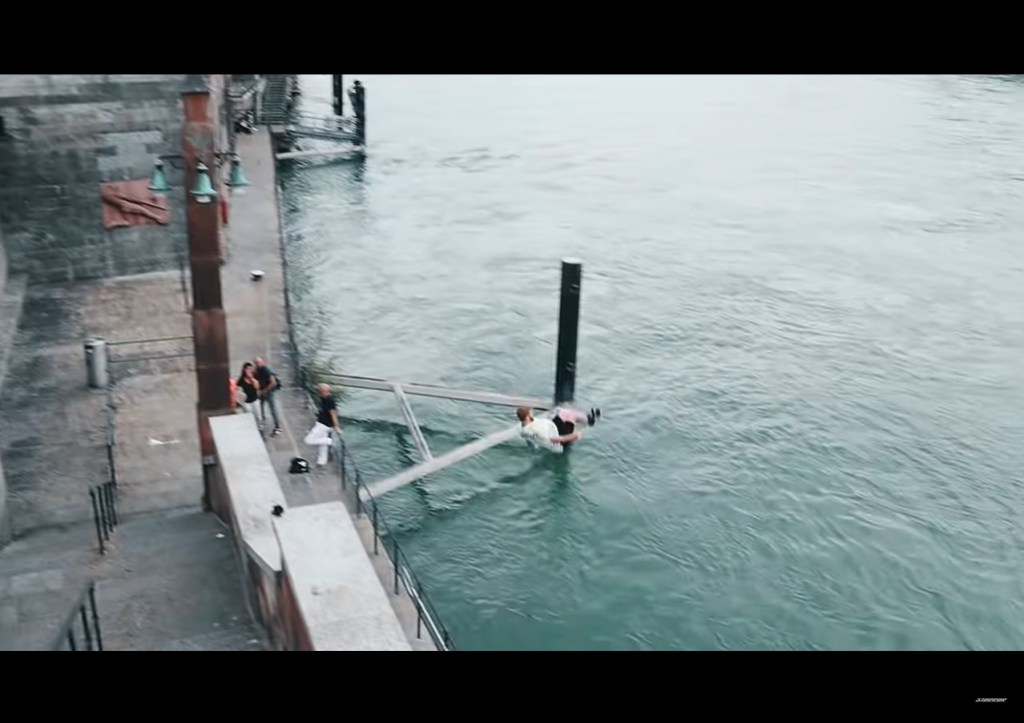
This video shows how the social dimension of these spaces that temporarily host Storror are almost inevitably drawn on by them during the course of making their videos. Bystanders and passers-by are often the stars that seal the firmament of the ‘show’ – awestruck or horrified, fractions and glimpses of places and people emerge.
These recurrent settings also ensure that the street can become a place of exceptionality, of possibilities creeping into the known from spaces of hitherto obscured distance or dimension, of timings, acts and events that transcend the normal planarity of interactions between humans and the mainstays of modern environment. As concrete has become a primary human environment; brutal and impearmable – then the extremity of humans making it a space of accelerated and elevated interactions has likewise been of an extreme. Facets of toughness paired with flexibility in body, mind and spirit – to find spacetimes opened of the exceptional within the edifice of the unyielding.
*
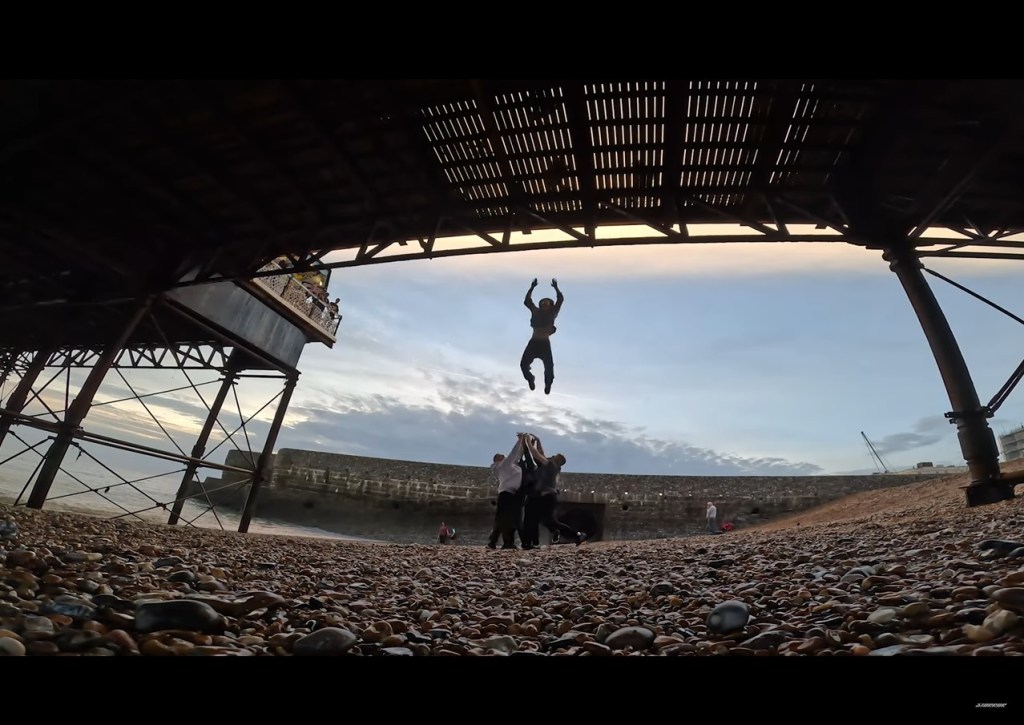
Storror are also filmmakers of real skill. Their video shot in Cappadochia, Turkey (and the making of video) are amazing as evidence of their imagination as well as how organised and ‘on it’ they are as athletes, filmmakers and performers. Sometimes when they present runs without sound or voiceover – so often immaculately curated with music as their videos are – they create a dream-like theatricality of the impossible being upturned before you, as architectures are traversed and interpolated with balletic precision and power. They also experiment with the format, tweaking things, adapting what they do to shift focus onto the group in different environments, or with unusual challenges, such as when they did the straight line marathon challenge or undertook relentless successive backflips to avoid eating raw chillies.
Heights / territoriality
Their rooftop POV’s and the work they did in Hong Kong, Tokyo and Seoul for the Rooftop Culture Asia film in 2017 are extraordinary for the daring and the vertiginous, stomach churning heights. These aspects of Parkour immediately foreground Parkour’s full-on attack on two differentially located blocking modes – the assemblage of the activation of fear and the human power authority mode that delineates and enforces territorial power. In terms of the latter that these ‘attacks’ are transient, rooted in art and the body and so obviously also performative and ultimately flagrant, make them all the more subversive against the deeper impacting systemic of the mode itself.
Their regular transgression over the opposition of private interest security (to whom they are almost always curteous) can be seen as a rebellion against architectural control-norms; the pre-defined usability of urban and concrete spaces. A built-in intensive reterritorialisation of built-environment spaces and the use of them to practise the deterritorialisations of the body. Once again, as a movement this can be said to be occurring at least twice, against the fear-paralysis of the body and also against the imposed liminality of what these spaces are and can be made to be a part of. In this respect, it makes most sense to think about deterritorialisation of the body in respect of its using these intensities of runs and moves and landings to establish a level of engagement simulteanously intrinsic to the spacetime, but extrinsic in intensity.
There are also two aspects of Storror’s work that I think vitally bear notice. The first is that they take parkour outside an urban setting as their Cappadochia video attests, so too their video in the desert and in Mexico (at a mayan jungle structure), or in the rock pillars of Slovenia and elsewhere – showing that parkour does transcend its urban exteriority and retains its key attributes in doing so. As such it is possible to imagine Parkour as an adaptive aspect of ongoing fluid and artistic engagement outside the specifics of any environment or the urban reality of now, to which it also needs to be added that the athletes incorporate trees into their locations at virtually every opportunity.
The second aspect is a thread in Storror videos that focuses on the theme of escape.
*
Parkour is fascinating in its directions of intensive dynamics, its minor name freerunning, its constant rebellious re-purposing of shared conurbation spaces, the inversion of meaning to the possibilities of these spaces in what they can be made to yield. As mentioned, there is the implied attack on concepts of property, power and the security-complex of property enforcement, while twinning this with a fugitive, nomadic treatment that involves feats of the extraordinary – which human beings are mostly transfixed and energised to see – and yet must seemingly territorialise over again and again in relation to their own lives or possibilities.
Pragmatics / Communication
There are lessons applenty from watching Storror and other Parkour athletes, in absorbing impacts and shocks, in slow-mo and detail, the full extent of techniques and the application of learning around the maximal dissipation and re-routing of impact-energy, it’s circles and spins and lines of continuation.
I think it’s also valuable to understand the context to some of the most very intense Parkour feats. After executing a particularly huge front flip to a wall at the Imax in London – then a world first at the location, Australian Parkour-brutalist Dom Tomato indicates he had done the jump in his head over 200 times that morning, while having been thinking about it generally for around two years (although part of that time included being locked down through the pandemic). A sense is given of the exceptional aspects of the mental-virtual in building up to a large scale, impact-heavy feat like this. Alongside which will come the reckoning of the athlete in the context of every particularity of the jump – and yet each occasion and space is always singular and immanent. ‘You never get used to that feeling of falling‘ as Drew says in one Storror video.
Similar to some martial arts, there is an explicit aspect that encounters and encourages animal-becomings, the Catpass is one technique, while in this video Storror make progress in India towards leaping across rooftops with a troop of local monkeys. At one point Drew makes reference to them becoming ‘monkeymen’. They are elated when they watch one monkey make a roof gap with epic ease, a distance beyond their own.

*
Spots, moves and techniques being ‘unlocked’ brings across gaming vernacular, but is also crucially close to the language of intensification and intensifying skills and capacities. Perhaps in a most valuable sense, it makes direct reference to something that was always there, but imperceptible or inaccessible. The spatial language of crossing thresholds.
In fact there is a coterie of adapted language at work to make possible the degree of communication necessary in high-risk spaces of exploration, in relation to distance/speed/time/surfaces, angles, power, impacts as well as the ongoing relativity of spaces to themselves and to others, to materials and installations.
As with their occasional reports on a specific danger of something like ‘directional leakage‘ for example, the realities of navigational possibilities aquire exceptional but fundamental elements – dimension in relation to vectors experimental to the space that can involve maximum consequence. In this respect their pragmatic information chains become completely intrinsic where valuable parameters, observations, experiences and understandings are shared as part of a creative group learning and thinking approach, utterly endemic and inseparable from the body.

* *
While art has always had transformation as its bedrock, it occurs to me that almost nothing could be as radical as this action that transforms the generally deadened spaces of our transit and walled communality into consequential scenes of performance. Imbuing moments of daring in the general mundaneity as we see becomings of bodies and groups, the possibilities of temporarily autonomous spaces and the trajectory of sustained will, operating when at its most creatively radical and serene towards a tip of the human wave of experience.



* * *
 reflectivewavelengths