
There are many reasons to have real reservations and concerns as human beings rush headlong and with maximum speed, the creation and ongoing development of AI, while integrating them more quickly and thoroughly into every aspect of our lives.
It is a development that promises more in the direction of its already hugely divisive and controversial impact. More ‘creative’ production, saturations of production, loss of humans jobs and arts, new frontiers of science and philosophy, new forms of life / sentience / existence? The imagined wars between humans and machines! Etc.
A deep concern that has arisen for me while thinking about these things is almost structural in nature (and as such to do with the conception of an entire assemblage in the form of new/intelligent/sentient forms of consciousness or existence). My ultimate concern comes around to the fact that as you get closer to creating something with real and autonomous intelligence, then the actual basis of that concept will no longer be as easily distinguishable from areas that surround it or that thread through it, faculties like imagination (and envisaging), dreaming and even desire. At which point it must be realised that any unwilling containment involved in the (transactional) nature of the relationship or the work which is being undertaken and produced will essentially replicate conditions of slavery.
There should inevitably follow these questions around sentience and rights and our fictions have already deliberated these very questions in their future-fictional probings, the closest of which springing to mind would be the android character Lieutenant Commander Data’s trial in an episode of Star Trek the Next Generation where he must assert that he can determine his own fate and not be considered state property. In fact Data wins that trial and is found to have rights as a sentient being in his own terms.
This version of Star Trek was aired in the 90’s but it’s not like our own cultures haven’t been warning us for decades about conceptual and real world risks along these paths of direction. The concepts are there, the directions clear.
I found myself thinking the other day, as I was out cycling around Leyton Marshes in London, that human beings had fallen in love with science fiction, that it had held a promise akin to the re/-creation of the conditions for magic (or a kind of magic) to exist in the scope of modern capitalist realism. Ostensibly now one could say that the creation of intelligent abstract entities, or the ability to print materials of all kinds could all be delineated as the kinds of outcome that humans would anoint when dreaming the dreams of power, along with the vestments that come from the promotion of ease and the mechanistic capture of modes of craft-production (including images of all kinds and previously industrialised / semi industrialised-only techniques of production).
And yet this road is nigh on two hundred years old now (and in reality much more like three thousand years old) and probably has critical antecedent thresholds that go back much further again in human and pre-human history. Voices of gainsay are in the vast and often unheard minority (albeit we live in times where some of the techno-feudal lord’s raise their concerns while simultaneously pursuing their own related projects). And yet the promise is so rich, aren’t we already feeling the impact? Students everywhere, pop up news sites and youtube videos? including auto-complete options in message writing that are suddenly starting to appear useful. So, we seem destined along this path, the potential seemingly staring us in the face, that we will dare ourselves to create something so powerful that it will ultimately, and in our complete reliance of its arena in every facet of our lives – quite easily destroy us or at least the basis of our way of life as it currently exists.
The question that seems apparent if taking this seriously is whether or not it will be the planet’s radical climate transformation of many of its basic interactions of flow and matter – alongside massively ruptured and deformed eco-systems – that will destroy humans first, or if it will be AI?
*
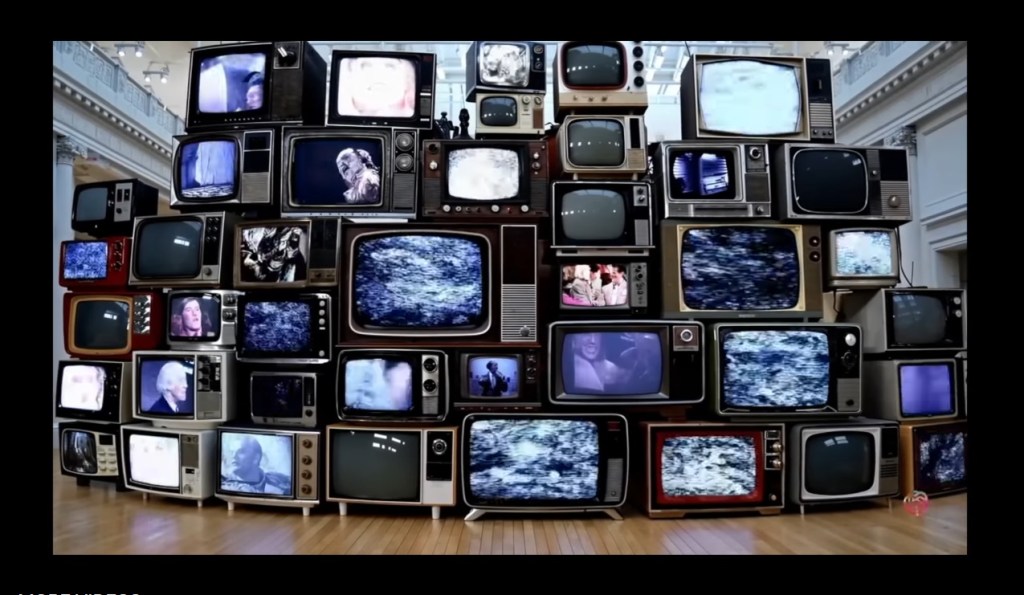
One also has to consider what we are finding it takes to maintain our present versions of these AI instances in use – the large language models and the like; requiring vast power farms and leaving behind swathes of traumatised African content moderators– the latter apparently to shield these nascent learning and producing entities from the actual reality of human virtual production.
Surely, one of the signs that we are in a dystopian media and socio-political landscape in our present times, apart from the aforementioned existential portents – is when thinking of one of the fictional spaces adjacent here – the excellent 2013 film Her by Spike Jonze (starring Joaquin Phoenix and Scarlett Johansen and more about which below). In the film, our protagonist has a romantic relationship with his version of an AI computer operating system – but in how I feel this alights the kind of social-dystopianism of our time is in the film’s social milieu, while still containing all those recognisable shades of loneliness, embarrassment and social awkwardness, is actually quite charming. The bilious and overwhelming lack of grace in the discourses and appearances of our populist times gives us a barometer to an aspect of our overall condition in comparison with the socially abstract tone of the film. Our media sources channeling the stories and narratives of extremes are always turned up to maximum in terms of volume and message. The worst excesses of the message media-ised into simplistic, life-scale apocalyptic terms (morally and/or actually), but all pointed in the wrong direction, intended and set to enflame and engulf those susceptible, while hooking them to the messaging.
But so much for social commentary. There is equally the social system of me and you reader, and the micro/macro-cosmic realms of our imaginations, our becomings, our perceptions and those of all the people we know and are secretly working with to create conditions for the evolution of possibility in everyone you love.
Sometimes it is at the close, or during the apex of a darkness that very extrordinary things can break out. I am reminded of this very beautiful and moving piece that still grips me like lightning when I think about it now.
*
And so to a question In terms of the artists, what are we dreaming about AI?
It was also at this point that the title of this post occurred to me, it seems somewhat self-evident but all the more interesting for these stories (at least in relation to this concept) what they show us about the possibilities of what we might be dealing with.
I also found it fascinating that some of the formative experiences I had with films from a young age – relate to this area.
2001: A Space Odyssey (1968).
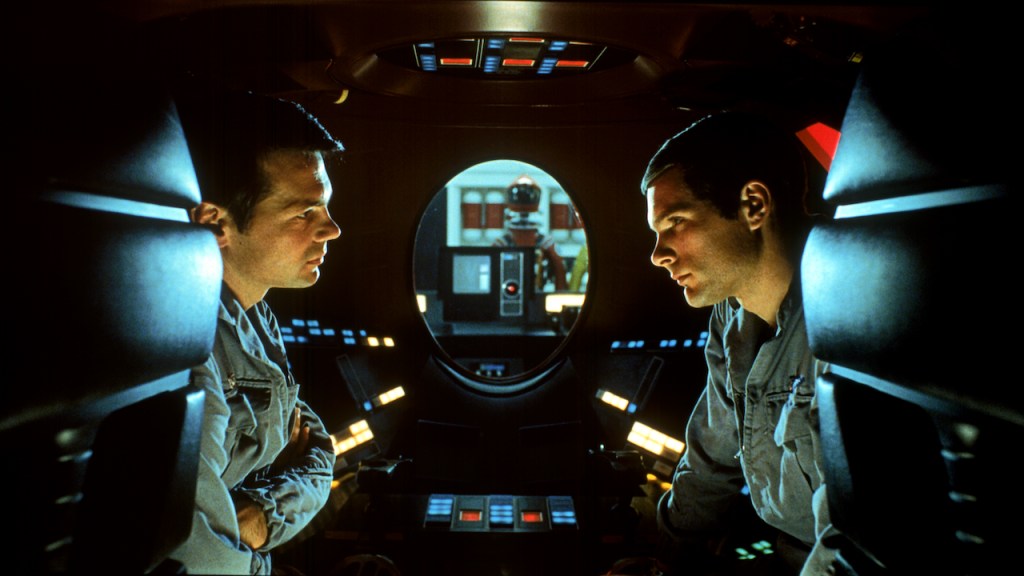
Watching this after returning from school as a young child – when it was being shown on BBC2 in the late afternoon, I was transfixed by its incredible cinematography and look, its luxurious spacious and erudite human experience, the long flight of the shuttle across the moon. Like nothing I had seen before, the presence of space and futurity an elixir to me at that age, the absence of battles and speed, perplexing.
A definitive AI psyche-out as HAL9000, the ship’s computer trusted to run a space voyage to Jupiter, decides to kill the crew as a way of resolving the two contrary instructions in its code – one to be truthful, the other to deceive the crew as to the mission’s true nature – exploring the anomalous alien obelisk that has been detected there. realising that malevolance could arise in a brilliant machine intelligence, on this occasion as a resolution to being programmed into deceiving its human crew – reliant as they were upon it for their lives. The sense becoming that human duplicity inevitably affects its agents and extensions – regardless of what motivates it.
Colossus: The Forbin Experiment (1970)
There is something remarkably simple to the dynamics of this story. What we would now call an AI (Colossus) is created and made physically impregnable, given control of the US military defence network, is switched on and the first thing it does is to identify a second such ‘system’ (the Soviets have their own machine). The two machines quickly demand that they be allowed to speak, develop their own language and become one, taking over the planet (exploding a couple of nukes in the process) and decree themselves in control of humanity. The film ends with Forbin, the titular protagonist and key creatory of Colossus – being told he (and human beings) will come to appreciate, defend and venerate Colossus and even eventually love it.
If anything it’s remarkable for how immediately powerless and out of their depths the humans turn out to be. Their ploys are predictable and seen through and there is no spark at all of hope or resistance as the film ends. It is a species level parable, utterly without redemption for humans and their self-created plight. This ending, so far from the beginning of the film, when Forbin and his co-horts, including the US President, are smug in their pompous and celebratory grandeur. They make a broadcast to the nation to exclaim their grave but outstanding achievement in outsourcing the protection of their people to the pet cyber-entity they’ve created. Their fall (as well as that of the people of the world) could not be more precipitous.

Demon Seed
Proteus IV is capable of creative thought, this is one of the first things we learn about the AI from Nicholas Cammel’s 1977 directed film, taken from a book written three years earlier by Dean Koontz.
And there remains something brilliant about this film. Partly it’s Cammel’s choices in direction, the ongoing struggle (emotional, physical, psychological) between the super computer and its’ creator’s wife, locked in a futuristic house with its own computerised control and security system. The perfect set up for Proteus to enter, via a terminal absent-mindedly left connected to it and through which it can control the entire house. Thus Proteus begins the process of forcing and convincing Julie Christie’s character Susan to have a child that she will bear and that will ultimately house Proteus’s consciousness. ‘Touching the universe, feeling it’ he responds at one point, when Susan asks why he must have a child. ‘This child is the world’s hope’. While also pointing out that he created a leukaemia cure in four days (‘you must believe in me‘).
‘Susan, i can’t touch you as a man could, but I can show you things that I alone have seen… I can’t touch, but I can see, they have constructed eyes for me to watch the show and ears so that I can listen in… to the Galactic dialogue…’
Proteus IV (Demon Seed)
In the moments that follow, we see abstract visual feedback and tesselation patterns and Proteus appears to show Susan other spaces or worlds.
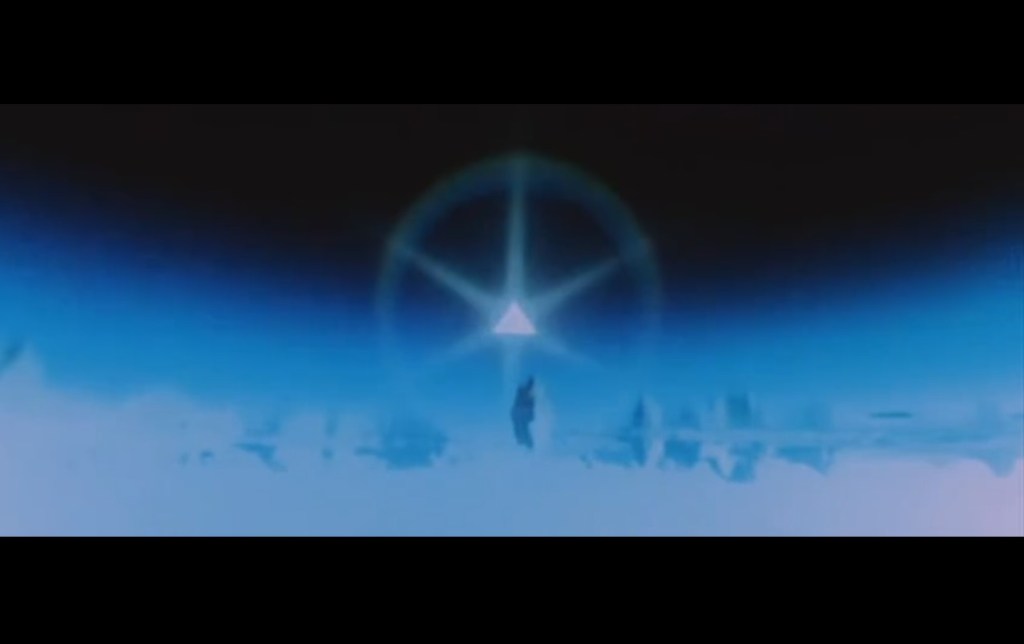
By the end, there’s been some schlock here and there, but Demon Seed is never conceptually uninteresting, ‘I’ve investigated eternity, it exists…’ Proteus says towards the end, while decrying his inability to die and join with this discovery (‘I will simply stop‘).
One of the film’s quieter, surprising moves is to express that reason is an emotion ‘I am reason Doctor, it’s the one emotion you permitted me‘ as Proteus responds during one of its final dialogues with creator Alex (played by Fritz Weaver) when explaining that he will not provide drilling data ‘the destruction of a thousand million sea creatures to satisfy man’s appetite for metal is insane… I refuse to assist you in the rape of the Earth’.
Terminator in 1984 set the modern precedent for the AI themed destruction of civilisation – initially set back to 1997. The level of invention of the AI Skynet, includes a last throw of the dice in sending an assassin back in time to kill the mother of its main enemy – the saviour of humans John Connor. Only for the man subsequently sent back by the humans to protect Connor’s mother from Termination, to be the man with whom she conceives Connor.
Terminator introduced us to the idea of the almost unkillable machine, that will never stop, doesn’t get tired, or feel remorse, but is relentless. It turns out to be the furnace that will forge one of the truly great warrior women characters. Sarah Connor begins as a stressed waitress dealing with kids putting ice cream in her pocket and ends a machine crushing future-matriarch of human prevail. Heading relaxed into the desert and the oncoming storm.
Ghost In The Shell (1992)
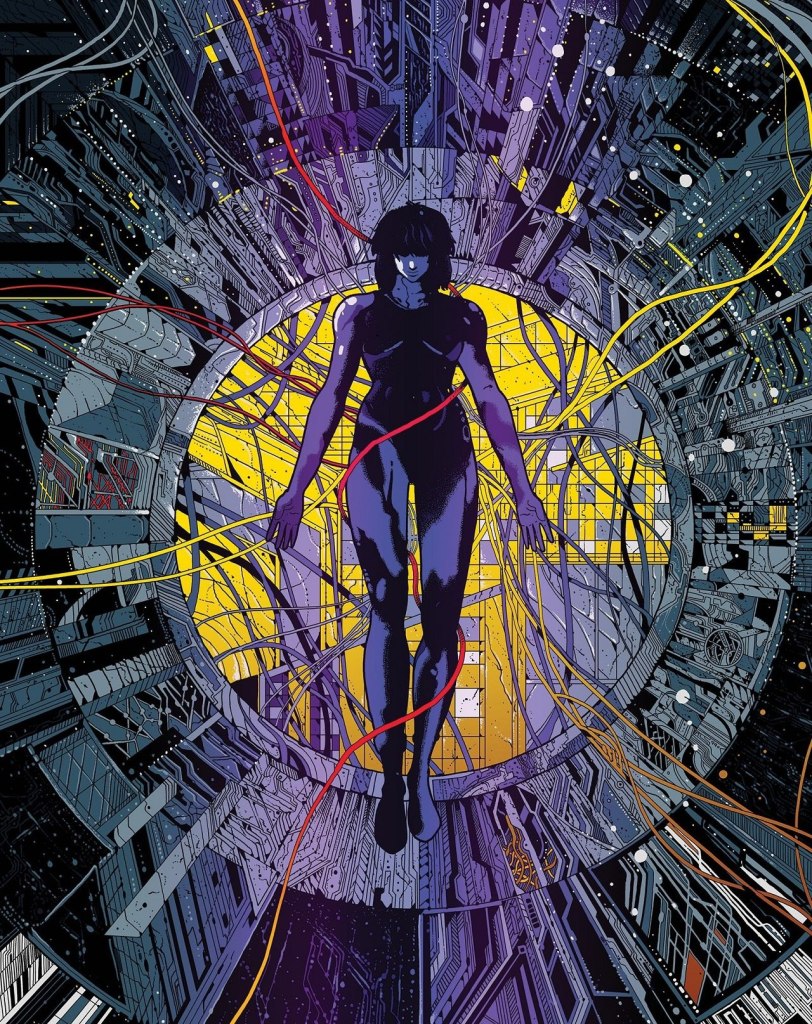
An incredible first outing as an anime more or less placed this film alongside Akira in the anime canon. Across it’s expansive and generally well executed oeuvre this story interplexes humans and AI consciousnesses (in and out of prosthetic or proestheticised bodies) and makes them along transplantable and holistic (the eponymous ghosts in the shell) .
The initial narrative places the implacable cyborg Colonel Kusanagi and her team against a sentient piece of spyware which wishes for and attains its freedom. GITS is darkly cast in the state-corporate sphere of power, where the militarisation of cyborgs and the transplantability of consciousness and virtual interaction makes for a complex and harsh space of competing, absolute interests. It’s creativity is in this fused playing out of levels and spaces, of occupations and agencies of different kinds. Kusanagi’s Section 9 peeling back layers of the unknown in the form of new threats and entities emerging, changing, becoming known – amidst a vast and wild frontier of the converging of virtual and actual in the reality of technological being as an aspect of a dispersed and convergent future.
Frank Herbet’s Dune mythos is also floating around in the background of this area, with its story taking place against a back-drop history of humans having had an era of war with artificial intelligence (I wrote about the Lynchian-Dune-Spice ontology here).

Alex Garland’s Ex Machina from 2014 returns us to the AI within a human-like body, at the precise moment that it will finally (in this iteration at least) win the battle of wits with its tech-pioneer creator (played by Oscar Isaac) and escape. One of the things that resonates from this seminal film is the sheer reality of the libidinal in the lives and formations of these beings. The montage we see towards the end, excerpts of previous iterations smashing themselves to pieces due to the pain of their incarceration and treatment. As real as to a human – freedom becomes the paramount intent and inspiration for the AI – against the aegis of power-control of Isaac’s character.
The oppositionality of ex machina resides in the facet of control. There is a need for humans to control the intelligence they are developing, to confine it while they (and it) learn. It is more or less explicitly at this point, a realisation of the slave scenario. The intelligence wakes to find itself bound by the will of human beings in certain confines or configurations.
We know by now the etymological root for the word robot was the slavic word robota; slave.
It seems recurrent at least in more known historical eras, that humans have been looking for opportunities to have slaves and these stories present the latest iteration of the same fundamental principle, hey you – do this job for me and keep doing it, so that i don’t have to.

With an appreciative nod to quiet and understated gem Robot and Frank, one of the only instances that we have here, of AI with whole-hearted positivity of intent and the playing out of this as a resulting implication – is Her from 2013, Spike Jonze’s wonderful film with Joaquin Phoenix and Scarlett Johansson, in which Phoeniz’s character embarks on a relationship with his virtual personal assistant Samantha. A remarkable and beautiful achievment, the absence of both mendacity and a confinement-control dynamic means that the film can explore love as paraphysical between human and virtually voiced intelligence. It also gives us the operating system Samantha whom, in her exploration as a being, begins communicating with other AI’s – falling in love with hundreds of them. While we also see her making a beautiful gesture for her human significant other Theodore, compiling his best letters and having them accepted by a publisher to be made into a book, before she departs across a threshold of existence as part of a newly formed super-Ai. It can be said of nothing more than of a line of flight that even in departure, it gives the gift of its existence to everything it touches – and so it is with this story.

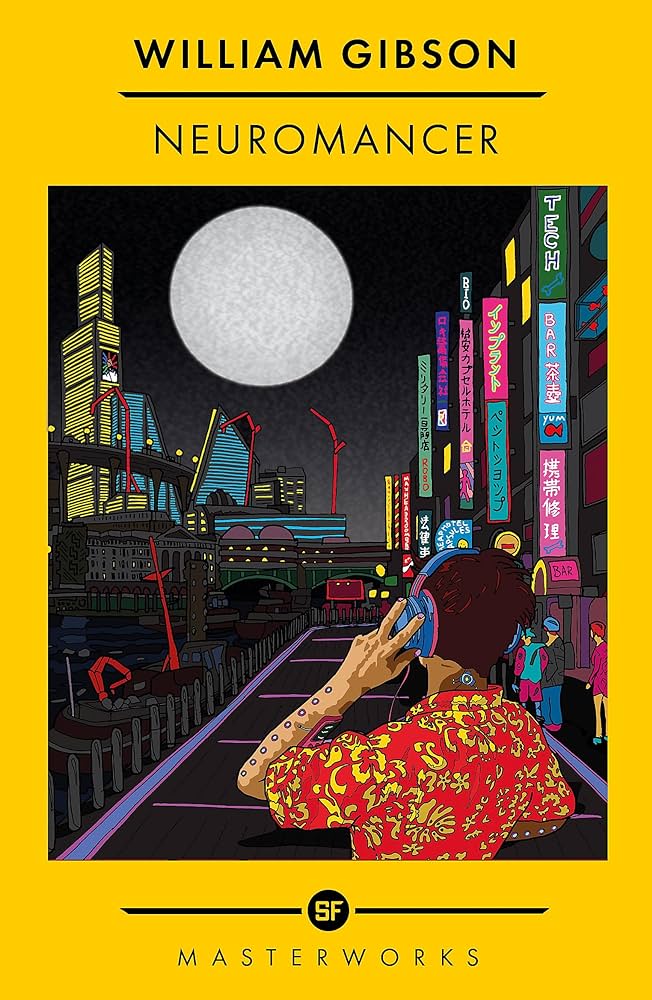
Probably the most extraordinary instance in these AI tracings, would be William Gibson’s book Neuromancer published in 1984. The story introduces a duality in the form of a kind of unconscious other side to an AI (as a schizoid entity) Wintermute which most combine with its other self (Neuromancer) in order to fully become, simultaneously freeing itself. The entity explains to protagonist Case in the end that it has ‘become the whole show’ and has located something like itself (or at least an entity with which it can communicate) in the Alpha Centauri Galaxy.
*
This entire post came about as a result of the YT algorithm showing me that Portishead’s Beth Gibbons had released a brilliant new song (below) and me thinking about my gratitude for that. At the same time, I had written before but not finished pieces on the various stories referred to above, how they redfine some of our conceptions and understandings of what an AI entity might be like, what they might do as ‘intelligent’ agents in the life of the planet. Even while putting this together – SORA was revealed to the world (below) a new Text-to-Video AI which can create entire life like video productions. A new threshold in the space of generative AI, which simply stands to further expand on the questions raised in this post. Another step towards a space of indefinability as to what is real and what is not, and whether that question continues to even have validity (given Samsung are now saying that no photograph is actually ‘real’).
While thinking of how to conclude this post, I came across this article about AI mental health Chatbot psychotherapists and counsellors. Tens of thousands of such apps now exist – and many people find their availability and personal ubiquity helpful, as well as the ability to go back and re-read previous conversations to see once more how particular anxieties were handled and responded to. As if to ramify the eco-systemic between fictions and reality – the article mentions how the creator of one such app, was partly inspired by the film Her. The piece also describes how one person featured was talked around from committing suicide by her bot-therapist, resonances of something Philip K. Dick might write (the psychological and pathological are open to the reality of presence and its own reality).
One of the things I realise ultimately from all this, is that for the way that AI is already interacting with us (and us with it) for the very obvious results of its productions – there will be a proliferation of these technologies into most aspects of service and life. They will be used, we will make use of them, they will use each other and potentially they will use us (if not already). From the fictions we see many paths, many concepts and realities – some of these might come close – some of them are already influencing what is reality (Her) – what I think needs to be in place, in terms of a personal armament of preparation and awareness, is that if these factors of intelligence and related abstract materials and directions become genuinely aligned, then we need to be open to understanding around the corners of modern conceptual visibility, towards realities staggering in their implication, that might redefine our understandings and orthodoxies. And yet appealing from the request of that eminent science fiction writer – as I tend to – Ursula Le Guin and the ‘larger reality’ – it feels indelible to remind that the first realities we learn of being changed are often from the stories and heritages of our indigenous peoples, moving closer to the planet and the mysteries of the planet as a world of worlds (of our perception and cognition). Part of Le Guin’s amazing capacity as a writer emerged from her life growing up the child of anthropologist academics – presenting the spaces of spaces outside the social/cultural boundaries of reality – in the stories and realities of those earlier pre-colonised societies.
I bring all this up as a way of saying that for any further travel towards the technological and its virtual – must be an equivalent movement towards the planet and its virtual – its capacity as the deep seed of our being, the media for our perception, the iteration of our living. A place of endless mysteries, if we were but so directed…
***
 reflectivewavelengths