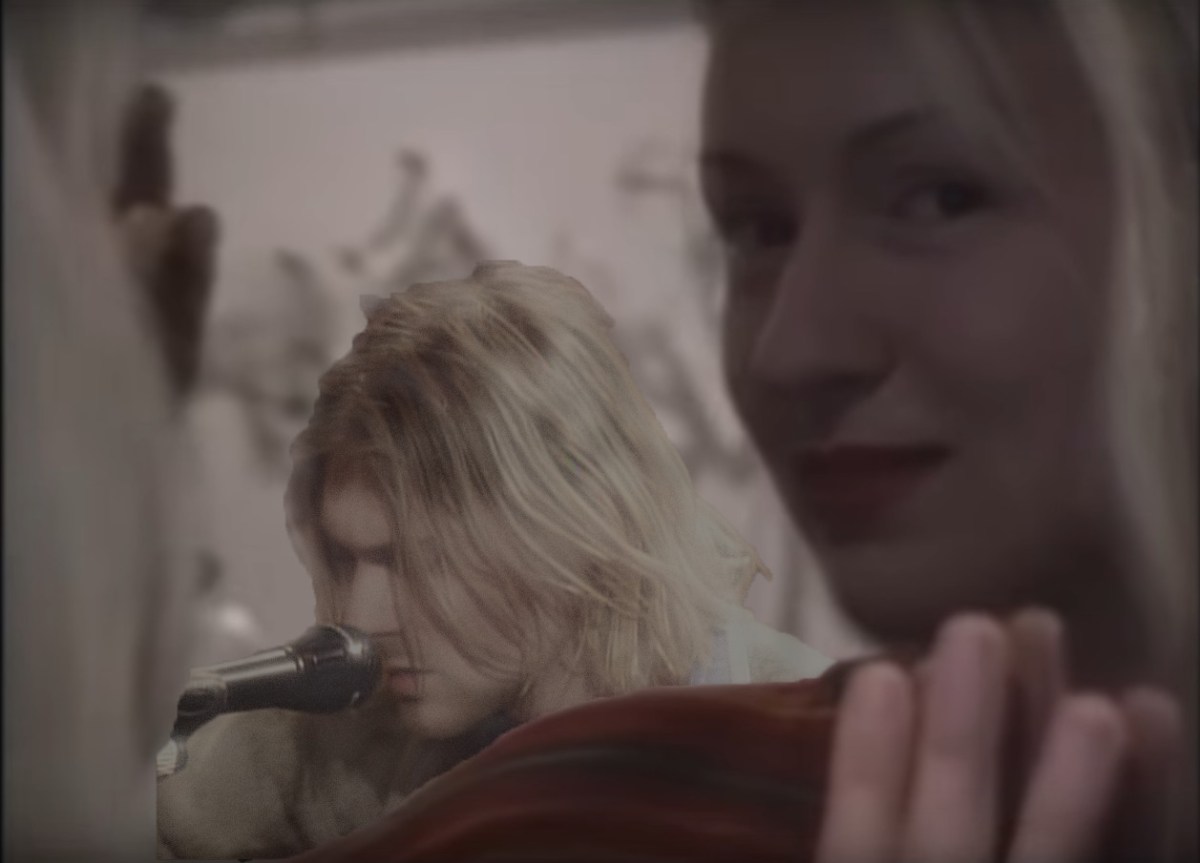
I recently found myself going back to songs from the second album by Smashing Pumpkins, 1993’s Siamese Dream and two songs in particular, Hummer (live – above) and Mayonaise (below).
Over the last few years I’ve returned to a lot of the music I listened to in the 90’s as I moved through the experiences from teen to young adult. Formative and transformative, music that felt like it was from a part of life that I needed – the discoveries and attractions of songs, subtle and powerful feelings conveyed through the high-energy vibration space that is sound.
A whole swathe of U.S alternative rock bands were part of this – newly empowered and emerging from the carcass of the 80’s exhibition rock, energised in part by the spirit of hardcore punk rock (Nirvana) and a heavier riffing sensibility – grunge, as it became known captured young hearts and minds. For myself and my small cadre of close friends – on a shared journey discovering – Smashing Pumpkins more than any other band encapsulated the actual sound of ‘grunge’, synonymous in our minds with their overblown macro-sounding distortion, magma to songs with the most delicious poppy hooks.
First hearing a cassette recording of 1993’s Siamese Dream not long following its release, handed to me by a friend with no context (‘just listen to this’) – lying on my bed in the sunlight, being entranced and somehow shocked that these songs and these sounds could be this good, this attractive and compulsive.
The introduction to Soma sounded just heavenly.
*
Even early on Billy Corgan, the band’s writer and lead performer didn’t seem to do himself many favours with various comments. Wikipedia documents some of the grievances and stinging criticisms against Corgan personally and the Smashing Pumpkins’ music as a whole. Well known producer/engineer and Shellac founder Steve Albini referring to them as ‘REO Speedwagon’ (“by, of and for the mainstream”). Bits and pieces I have come across in the time since then don’t particularly inspire confidence as to the ideas about other people and himelf that seem to be at work with regard to Corgan (Pitchfork in this piece refer to a podcast appearance in recent years with a particularly noxious conspirary theory conspiracist).
*
As such it’s been interesting just how much Smashing Pumpkins had fallen off the radar for me personally.
When the much anticipated follow up to Siamese Dream – their double album Mellon Collie and the Infinite Sadness – was released in 1995, I felt immediately that the bubble had burst, for me at least. That there were good songs (1979 and Tonight, Tonight spring to mind and I’m sure others) but the sense pervaded that overall these had been subsumed in a tide of bloated self-indulgence.

There was also a kind of double re-positioning that was taking place culturally around that time, grunge faded and the libidinal taste-edge of alternative music production moved to Post-Rock and newly emergent strands of techno and electronica. This ossifying rock music once more – as in the UK and elsewhere it was also returned to mainstream acceptance after years of being in the fashion-basement of indie.
*
I retained a dim awareness of the different Smashing Pumpkins phases that followed, my foray into the ‘Adore’ album limited as the songs seemed to sap any sense of necessity in my response. Unlike with some of his musical peers at the time, it was noticeable that none of the lyrics came out of the songs and assumed a meaning or life of their own in our midst. From the first songs that catapulted Nirvana, an alterity was evident, a perspective that could use poetic-lucidity (to use Justin Barton’s phrase) to convey something beyond the confines of the normative reflective identities of formation – in this instance a sense of entitlement as part of a generational production, a passivity with a vacuity and self obsessed self-importance (‘here we are now entertain us… / I’m too busy acting like I’m all naive, i’ve seen it all, I was here first…’) – placing these as spars in a reportage on the deep problematics of normative human ontology.
Of course, a lot of time and experience has been shared with the music of Nirvana between Nevermind and now. For example, I have no doubt that at the time of our lisrtening, neither myself nor my friends had made contact with David Bowie sufficient to know that Space Boy – from Siamese Dream was an obvious homage to the early Bowie song Space Oddity (from 1969). Although listening once more after so many years, Space Boy does not seem to shine particularly.
*
I definitely perked up in the general Corgan direction when I heard in the early 2000’s that he’d formed a band with (among others) David Pajo of Ariel M, Papa M and erstwhile of Slint, Tortoise, many other bands and a favourite guitar presence in my listening for many years by then. Although the band they’d formed – Zwan – in the end didn’t ignite in a sustained direction, I recall finding some of the song parts interesting, but when they disbanded in soon to be considerable acrimony, I wouldn’t have called myself a fan. It wasn’t until a couple of years ago and the pandemic, that I re-visited Zwan and found a few quite beguiling songs.
There’s enough quality and life to something like Settle Down (above) to imagine that Corgan was relatively invigorated for the process of forming and recording with Zwan and the live version of many of the songs from their sole album ‘Mary Star of the Sea’ from this performance contain striking moments of stretched-out melodic interplay (especially the longer section of ‘For Your Love’). Also, not to potentially undercut the contributions to these songs of Pajo, Matt Sweeney, Paz Lenchantin as well as SP’s own Jimmy Chamberlain (all successful and perceptive musicians) who between them formed Zwan.
Of later and current Smashing Pumpins lineups, my listening has been less than diligent, though one track did leap out, 2012’s The Everlasting Gaze with the intensity of riff structure, opening out into a sonically blasted chorus that flies with real feeling.
*
It is often a question regarding artwork and the artist, the personality traits and opinions of the artist, and their relation or not to the perception of their work (even recently Picasso’s grandson defends the painters’ behaviour toward women). However, I bring it up here, only to question whether or not adherence to a different regime of realisations would have brought Corgan to a place where songs with the qualities of The Everlasting Gaze or even beyond it might have been much more prevalent (it does suffer in some respects still from Corgan’s hypertrophied self-expression of self ‘…I’m not dead‘). It would not be possible to point to someone like Kurt Cobain as an emblem of difference in respect of the macro-trajectory of his life (and it maybe that Cobain’s death is forming part of a reference in that Corgan lyric). Although I think what becomes clear however Kurt Cobain was finding the day to day living of his life, is that his focus in songwriting and lyrics was incisive while also managing to be oneiric, having that dimension of an extraneous consistency which sometimes can only be glimpsed with fragments of understanding. As well as the anger that came with his writing, was a remarkable sensitivity, that found expression in these energetic songs, bathed in a worlded lyricism – born from intensified perception.
*
De-territorialisation and Nirvana
While a song that from the very first line announces itself to partly be about alienation, the Nirvana song Territorial Pissings has always struck me for what it does with this concept from its first utterance ‘When I was an alien, Cultures weren’t opinions…’ It establishes immediately that the perspective here is not from within the norms around which these cultures may swirl. A flattening out towards the vectors where alienation is an aspect of encountering the outside, simultaneously a vantage point unencumbered by a purloined interiority. A deterritorialisation of the perception around concepts that transect culture and societial cognitivities – while titularly eponymising this very thing ‘Territorial Pissings”; the possessive given a reactionary dimension of curtailment, backgrounded with the threat of enforcement and the constant potential immanence of ownership-power. Placing this concept at the head of a lyrical, song-writing endeavour referencing culture and alienation sees into the space as to the trans-positioning of different but related intensive forms of control and stratification, affecting both culture(s) and being(s).
The song has the effect of ontologising this alienation as feeding an aspect of lucid understanding – ‘Cultures weren’t opinions‘ flows directly from this condition of being outside normativity/ daily life. Cobain also suggesting the kind of intensive reality of all points of view as facts of existence, irrespective of their connection to accuracy, truth or underlying understanding. It could be argued that this presaged the following thirty years as media-cultures have flown into a war between meta-narratives of reality.
What makes this all the more poignant and possibly recognisable is that Cobain refers to this circumstance, the story of a particular lucidity of alienation in the past tense. A position reached but not maintained, as such the chorus – in connection, reads as a paean to finding a way returning outside in terms of the perception of something that requires a ‘better way‘ (and that ultimately requires patience).
‘Gotta find a way, find a way, when I’m there… /a better way, I’d better wait‘.
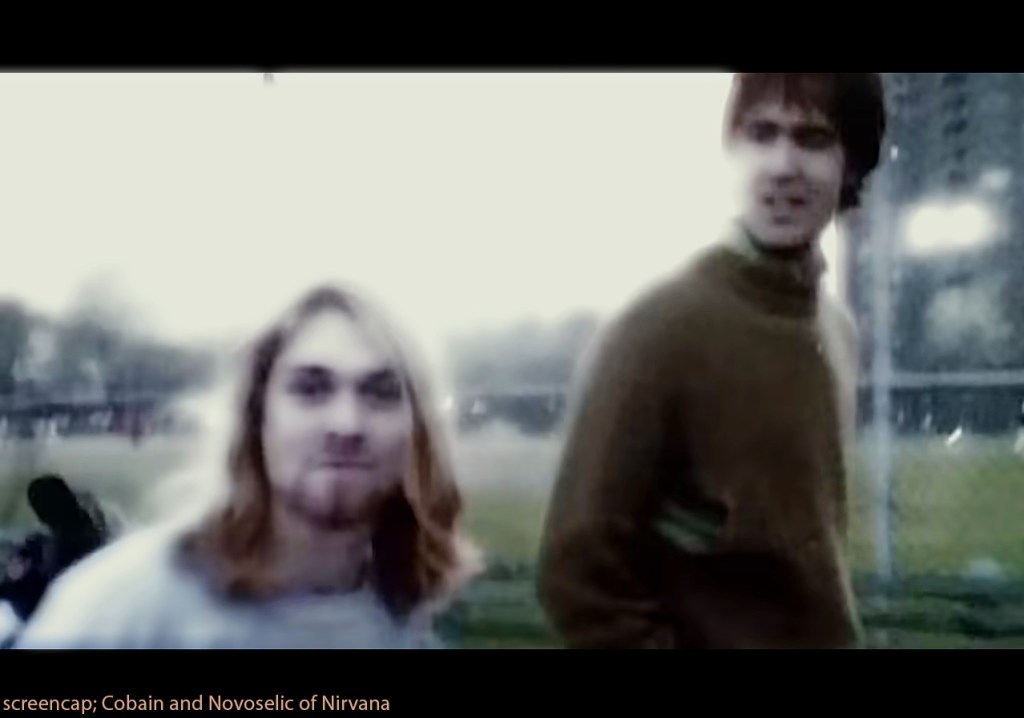
The song is inwardly-perceptive (of our problems and structures), that includes aspects of what else reaches in to inhibit and disrupt those fluencies and understandings, that freeing up – namely territoriality (‘opinions‘ as culturally defining) and the obscured reality of any kind of intensive cartography (the ability to see these things in the first place). There is pathos to the chorus lyric refrain ‘...a better way/when I’m there‘ If there is where understanding proliferates, to use that understanding to better maintain being in the place where it continues to intensify.
*
Sometimes, it might be possible to glimpse something of an artist, an aspect of them and their work somehow elsewhere, or in a different vein. In these moments, someone like Kurt Cobain can become a very captivating presence and what he is elucidating becomes secondary to a form of worship that concentrates on his being and persona. The resulting cultural feedback from this can be to narratively reify that ‘too much is read into his work’ – a move that cuts alterity from the space and reduces it lyrically to collections of more or less meaningless dysjunct.
Then, you realise that it is strange in listening to and thinking about Nirvana, to consistently come across ideas, concepts and viewpoints that hit at the edges of your thinking, extend uncannily upon the strange or unsuspecting aspects of your understanding. And what strikes me most in this context is a feeling of just how much there is a sense of the unconscious in this work. The unconscious at its most vibrant, precise and perspicacious. Which has added to the sense of there being these germinal, geminal plantings from years of listening to Nirvana, like lyrical collages whose connection and understanding grow and ferment and transform over time.
*
The Posies, 1993
When I began writing this piece, I had not anticipated including anything about Nirvana, but it was what arose (to quote the Dao De Ching ‘occurrence appearing of itself...’). In re-visiting the very mixed sensibility of Smashing Pumpkins, instead I had wanted to refer to an album (and a group) that coincided – perhaps somewhat strategically, with the grunge sound, producing a brilliant and sonically luminous album, and yet never attaining the popularity or success as so many other bands often creating less interesting or satisfying music.
1993’s Frosting on the Beater represented something of a change in sound from the Posies previous album, the mostly acoustic Dear 23 (1990). Melodically sharp from the outset, an intense charge to songs like the dark-pop power punch opener ‘Dream All Day’ (above) – chiming and slashing guitar lines and the excellently oscillating snake-like quality of its bassline.
Found by one of my close friends, Frosting became something of an instant classic among us and we carried and shared it with many people. It had a lovely vinyl reissue in 2018 – remastered with new liner notes from songwriters Ken Stringfellow and Jon Auer.
Although they didn’t pierce public consciousness in the same way as others, there are pockets of appreciation that continue to acknowledge the qualities of the album. Pop Matters in this piece describe the move from Dear 23 to Frosting as the point at which ‘…the Posies subsumed those early XTC-isms and other influences into a distinct mode and found their own sense of the timeless.’
*
As part of the 2018 reissue, Auer and Stringfellow’s notes comment on the times and the songs, their inspirations and recollections of the circumstance. Stringfellow foregrounds how much of the record was influenced and inspired by women. Perhaps unsurprising in the field of male-rockism and the song traditions of love, yet they primarily place this inspiration among the platonic. Sometimes through the harsh refrains of loss, something comes through. ‘How she lied by living’ (Live – above) with its beautiful, tightrope walk of a riff, juts back and forth, cutting through to the jagged heart-worn verse and its growling repudiating chorus, punctured with ferocious drum fills. It remains a wounded inspiration, simultaneously a warning sign in the sonic road.
The album is littered with songs that show a defining understanding of song dynamics and melody, with an approach that allowed for the harder edges of guitar music to come in and give that much more edge to the delivery of thoughtful, sometimes painful lyrics. When Mute Tongues Can Speak (below) has a surprising muscularity to it – (certainly evident when they are speed-riffing it live) remonstrating with returning flight to the scene of broken experience ‘dissected birds are my adopted family…’.
What is clear to me about the album is how much it is a whole – where the sonic integrity and spark of the songs run consistently throughout, giving a sense of each resonating and lifting the others as part of a mavellously integrated whole. They are constructions of beautifully carved tunery, vehicles almost crystal-like in their distorted metalicity, ultimately bent to a very human and melodically lambent telling of stories in sound and words.
***
(Title image mashup: AR)
 reflectivewavelengths